How Red Carpet Interviews Became Social Media’s Favourite Format

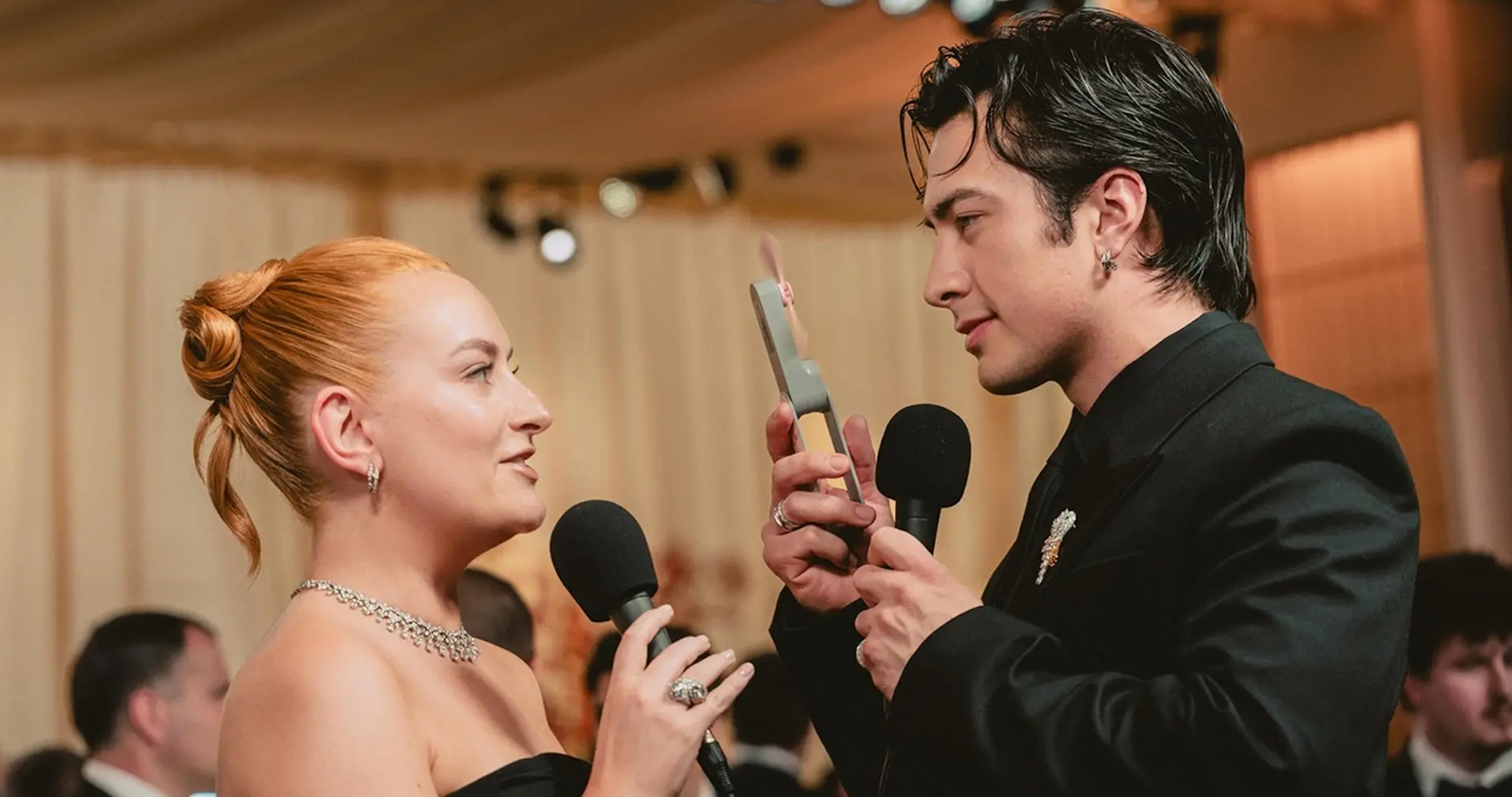
At this year's Oscars, Amelia Dimoldenberg asked Ethan Hawke for advice on unrequited love. He told her that the person who loves always wins, that the sun doesn't care whether the grass appreciates its rays…it just keeps shining. She said she might get it tattooed on her forehead. The whole thing lasted maybe forty seconds, in a noisy corridor, before someone else was ushered in front of the camera. By the following morning it had been watched and rewatched by people who couldn't have told you who won best picture.
Culturally, that's where we’re at now. The ceremony is still happening and the speeches are still being given, but the moments that actually travel (the ones that end up on your phone whether you watched or not) tend to come from outside the building. A year earlier it was Dimoldenberg and Kit Connor, her joking that he was losing his Oscars virginity with her, him completely disarmed by it. Before that, Timothée Chalamet's butter yellow suit generated more debate than most of the acting categories. The red carpet has been around forever, but somewhere in the last few years it started doing something different. It became the thing people, on a significantly larger scale, actually wanted to watch.
It helps to understand how strange that is, historically speaking. For most of the twentieth century, getting on television required institutional permission, that being, an established network, a commissioning editor, someone deciding you were worth the airtime. That gatekeeping shaped everything about how broadcast media felt: the formality, the distance, the sense that you were watching people who had been selected and approved. YouTube started pulling at that, slowly at first and then very quickly, and by the time TikTok arrived the whole logic had inverted. Audiences had spent long enough watching people talk directly to camera, unscripted, in their own spaces, that the old register had started to feel slightly strange. Like being spoken at rather than spoken to.
The red carpet was never designed to be a creator format. It's chaotic and time-pressured and fundamentally uncontrollable, which is precisely what makes it work now. Celebrities turn up mid-adrenaline, in clothes they've been thinking about for months, fielding questions they haven't prepared for, and sometimes something real comes out of that. Dimoldenberg has talked about how much she prepares, researching everyone she might speak to so thoroughly that by the time she's actually on the carpet she can let all of it go and just be present. That's what made room for Ethan Hawke's unsolicited meditation on the sun and the grass, and for her exchange with Heated Rivalry star Hudson Williams, who arrived holding a handheld fan and ended up dancing with her in front of the cameras. Neither of those moments was planned - and that at its very core, was the whole point in itself.
The Academy has been watching all of this and drawing its own conclusions. This year was Dimoldenberg's third consecutive year as the Oscars' official social media ambassador, a role that didn't really exist in its current form until recently, and she wasn't alone. Brittany Broski, Jake Shane and Quenlin Blackwell were covering the Vanity Fair party.
The ceremony increasingly has a whole parallel production happening around it, running on creator logic rather than broadcast logic, and the institution has decided to lean into that rather than manage it from a distance.
For brands, the appeal is obvious in a way that's become harder to dismiss. Dimoldenberg's YouTube channel has nearly a billion views. That audience travels with her to the carpet, along with whatever trust she's spent years building with them, and neither of those things can be bought outright or faked convincingly. A creator at an event isn't just another piece of coverage, but rather, they're a way into a community that might not have been paying any attention otherwise. The brands that understood this early have found themselves somewhere different to the ones still spending on traditional placement, not necessarily bigger, but somewhere the attention is actually real.
What nobody's quite worked out yet is what happens as all of this gets more intentional. The reason those clips spread is that they feel genuinely unmanaged — like something that wasn't supposed to happen, did. Start engineering for that quality and you tend to lose it in the process. The creator economy talks about authenticity constantly, almost to the point of meaninglessness, but it remains the most precise word for whatever it is that's actually being described. It's also, reliably, the first thing to go when it becomes a deliverable.
The carpet is still one of the few places on a major stage where that quality can plausibly exist. For how long, under this much scrutiny and commercial interest, is genuinely unclear.
MORE FROM THE FEED
UNLEASH THE POWER OF CREATOR